
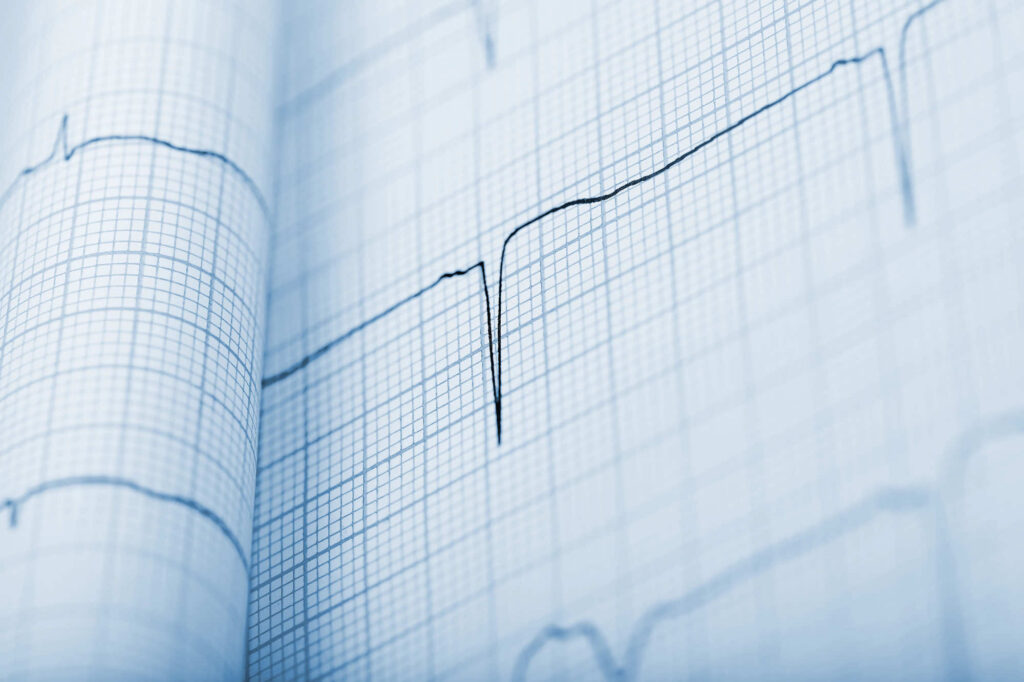
The ECG, short for electrocardiogram, is a fundamental and informative examination in cardiology. In our Kardio Pro practice in Düsseldorf, the ECG is the basis of many diagnostic investigations, as it provides valuable information about the function and condition of your heart quickly, painlessly and without any risks. Dr. Raphael Bruno and his team use state-of-the-art ECG technology to precisely record and expertly evaluate the electrical activity of your heart. This examination is often the first and decisive step in the detection of heart disease.
The ECG: What exactly does this test measure?
The heart is a muscle whose rhythmic contractions are controlled by weak electrical impulses. Each individual heartbeat generates a characteristic electrical field that spreads to the surface of the body. A ECGdevice is able to measure these minimal electrical voltage changes via electrodes placed on the skin and display them graphically as a curve - the so-called cardiac current curve.
This curve provides the cardiologist with detailed information about:
- Heart rate: The speed at which the heart beats (number of beats per minute).
- Heart rhythm: The regularity of the heartbeat. Irregularities (arrhythmias) can thus be reliably detected.
- Excitation formation and propagation: The origin and path of electrical impulses in the heart. Disturbances in this conduction system (e.g. a bundle branch block) are detected in the ECG visible.
- Indications of heart disease: The ECG may show typical changes that indicate an acute or recent heart attack, an inflammation of the heart muscle (myocarditis) or a thickening of the heart wall.
The evaluation of an electrocardiogram requires a great deal of experience and specialist knowledge in order to correctly interpret the fine nuances of the curves and place them in the overall clinical context.
The different types of ECG in our Düsseldorf practice
Not all heart problems occur permanently. Some only show up under stress or at certain times of the day. In order to obtain as complete a picture as possible, we use various types of cardiology tests in our cardiology practice in Düsseldorf. ECG-The results of the study are tailored to the respective issue.
The resting ECG (12-lead ECG)
This is the standard form of examination. It is carried out while lying down in a relaxed atmosphere and only takes a few minutes. Ten electrodes are attached to the chest, arms and legs, which record the cardiac currents from twelve different angles. The restingECG is the basic diagnostic test for almost every cardiologist's first contact and provides a snapshot of cardiac activity.
The exercise ECG (ergometry)
With the loadECG the cardiac current curve is recorded under defined physical exertion, usually on a bicycle ergometer. The aim is to detect changes that only occur under stress. This is particularly important for the diagnosis of coronary heart disease (CHD), in which constrictions in the coronary arteries can lead to reduced blood flow to the heart muscle. At the same time, blood pressure behavior and possible arrhythmias are assessed under stress.
The long-term ECG (Holter ECG)
To record a long-term ECG, you carry a small, portable recording device with you, usually for 24 to 72 hours. Your heart rhythm is recorded continuously over the entire period using three to five electrodes attached to your chest while you go about your normal everyday life. This method is indispensable for clarifying only sporadically occurring cardiac arrhythmias, such as heart stumbling or palpitations, or unexplained fainting spells (syncope).
Comparison of the most common ECG procedures
ECG type | Aim of the investigation | Duration | Typical indications |
Resting ECG | Recording of cardiac activity at rest | approx. 5-10 minutes | Basic diagnostics, suspected myocardial infarction, arrhythmia |
Exercise ECG | Assessment of cardiac function during exercise | approx. 20-30 minutes | Suspected CHD, clarification of chest pain, high blood pressure |
Long-term ECG | Recording the rhythm over 24 hours | 24 hours (or longer) | Cardiac arrhythmia, dizziness, fainting spells |
The decision as to which ECG-Dr. Raphael Bruno decides which procedure to use based on your symptoms and medical history.
ECG evaluation: What your heart specialist can recognize
A single prong in the ECG may seem insignificant to the layman, but may contain a wealth of information for the experienced cardiologist. Precise analysis of the cardiac waveform enables the diagnosis or at least a well-founded suspicion of a variety of cardiac conditions and diseases.
With the help of the ECG, we can make the following findings, among others:
- Cardiac arrhythmia:
- Heartbeat too fast (tachycardia)
- Heartbeat too slow (bradycardia)
- Irregular heartbeat such as with atrial fibrillation or extrasystoles (palpitations)
- Circulatory disorders of the heart:
- Typical signs of an acute heart attack
- Indications of a previous („silent“) heart attack
- Signs of hypoxia under stress (coronary heart disease)
- Changes to the heart structure:
- Evidence of thickening of the heart wall (cardiac wall hypertrophy), often as a result of long-term high blood pressure
- Signs of strain on the right or left heart
- Inflammatory heart disease:
- Specific changes that may indicate inflammation of the heart muscle (myocarditis) or inflammation of the pericardium (pericarditis)
- Other findings:
- Electrolyte imbalance (e.g. potassium deficiency or excess)
- Side effects of certain medications on the heart
The ECG is therefore an indispensable tool in cardiologic diagnostics in our practice in Düsseldorf.

The ECG procedure at Kardio Pro Düsseldorf
We want you to feel that you are in good hands during every examination. That is why we attach great importance to a transparent and calm process, especially for such a central examination as the ECG.
A restECG usually proceeds as follows:
- Preparation: You will be asked to uncover your upper body. Our medical assistants will ask you to lie relaxed on an examination table.
- Attach the electrodes: Small adhesive electrodes are placed at defined points on your chest, arms and legs. To ensure optimum electrical conductivity, the skin at these points may be briefly cleaned.
- Recording: The ECG device is started. The recording itself only takes a few seconds to a minute. During this time, it is important that you lie still and do not speak so as not to disturb the measurement.
- Conclusion: After the recording, the electrodes are removed again. The entire procedure is completely painless. You only feel the application and removal of the electrodes on your skin.
The ECG will then be evaluated by Dr. Raphael Bruno, who will explain the findings to you in an understandable way.
Frequently asked questions about the ECG (electrocardiogram)
Below we answer some of the questions that patients often ask us about electrocardiograms.
Is an ECG painful or dangerous?
No, a ECG is a completely painless and safe examination. No current is conducted into the body; the device only measures the body's own, very weak electrical currents of the heart. You do not feel anything from the actual measurement and there is no radiation exposure or side effects.
Do I need to prepare for an ECG?
For a restECG or long-termECG no special preparation is necessary. You can eat, drink and take your medication as usual. For an exercise ECG, you should bring comfortable clothing and sports shoes and not eat a large meal shortly before the examination.
What does it mean if my ECG is „not OK“?
A conspicuous ECG-The finding does not necessarily mean that there is serious heart disease. It is initially an important diagnostic indication that needs to be followed up. Dr. Raphael Bruno will always evaluate the result in the context of your symptoms and further examinations and explain to you exactly what the findings mean and what further steps may be appropriate.
How long does it take until I receive the results of my ECG?
The results of a resting or exercise ECG are available immediately after the examination and are usually explained to you by the doctor immediately afterwards. The evaluation of a long-term ECG takes a little longer, as the 24-hour recording has to be analyzed. You will usually be given a separate appointment for this or will be informed of the results by telephone.
Why does an ECG sometimes have to be repeated?
A ECG is always a snapshot. As the condition of the heart can change, it makes sense to repeat the examination at regular intervals for certain clinical pictures or to monitor a therapy. This allows us to assess the course of the disease and adjust treatment if necessary, which is an important aspect of modern cardiology care.
Can an ECG predict a future heart attack?
A restECG cannot make a reliable prediction about a future heart attack. However, it can reveal risk factors or existing damage that increase the risk of a heart attack. An exercise ECG is more informative here, as it can show circulatory disorders during exertion, which are a significant risk factor for a heart attack.
What is the difference between an ECG and a cardiac ultrasound?
The ECG measures the electrical activity of the heart and provides information about rhythm and conduction. Cardiac ultrasound (echocardiography), on the other hand, is an imaging procedure that shows the structure of the heart. It shows the size of the heart chambers, the thickness of the walls and the function of the heart valves - information that the ECG cannot provide. Both examinations therefore complement each other perfectly.
Can interfering factors influence the ECG result?
Yes, that ECG is a very sensitive measurement. Muscle tremors, strong movements or talking during the recording can interfere with the curve and make the evaluation more difficult. Our experienced medical assistants therefore ensure a quiet environment and give you clear instructions to ensure a high-quality and meaningful result.
Is an ECG also performed on children?
Yes, this is also the case for children and young people. ECG is an important and uncomplicated examination method, for example to clarify congenital heart defects, cardiac arrhythmias or as part of sports medical fitness examinations. The electrodes and the evaluation criteria are adapted to the age-related characteristics.
What does „sinus rhythm“ mean in the ECG findings?
The term „sinus rhythm“ is the normal finding in the ECG. It means that the electrical impulse for the heartbeat comes from the heart's natural pacemaker, the sinus node, and that the heartbeat is regular. If this term is found in your findings, this is a good sign from a rhythmological point of view.
Keeping an eye on your heart health: The ECG in our practice
The electrocardiogram is and remains a cornerstone of cardiologic diagnostics. At the Kardio Pro Düsseldorf practice, the ECG in its various forms forms the basis for responsible and well-founded care of your heart health. Dr. Raphael Bruno's expertise ensures a careful evaluation and a clear explanation of all findings. If you are due for an ECG examination or are concerned about your heart health, please make an appointment.

 German
  English
  Arabic
  Japanese
  Chinese
  Russian