
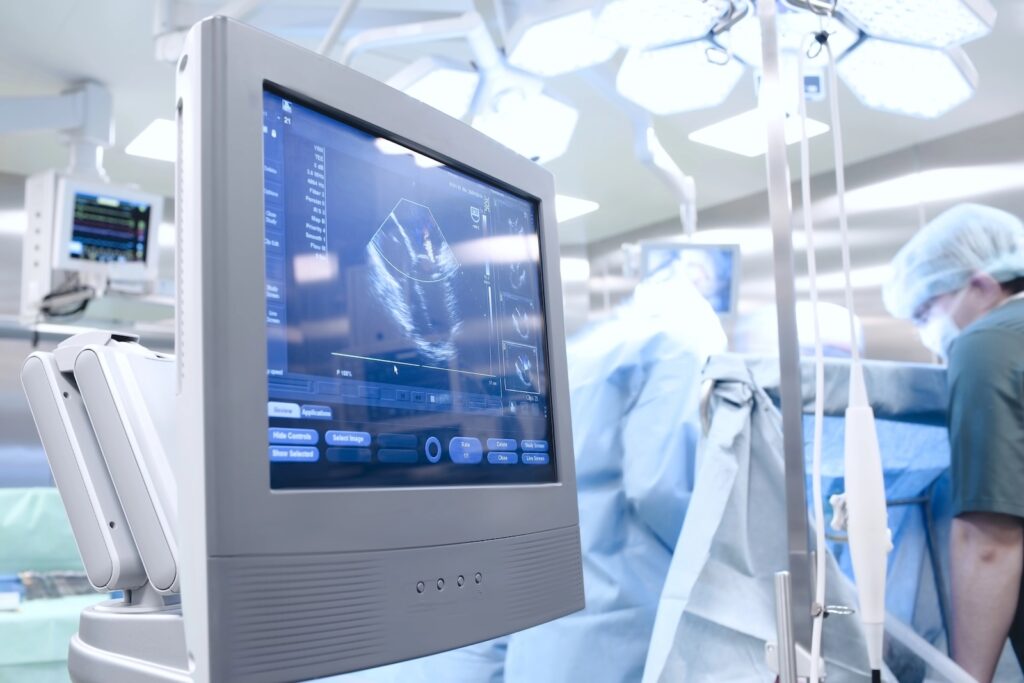
Cardiac ultrasound, technically known as echocardiography, is one of the most important routine examinations performed by a cardiologist to assess the health of your heart. This modern and completely risk-free method allows us at Dr. Raphael Bruno's practice to observe your heart at work and obtain detailed information about its structure and function. A Cardiac ultrasound is painless, does not require any radiation exposure and immediately provides valuable results that form the basis for a precise diagnosis and successful treatment.
When is a cardiac ultrasound useful? Frequent medical questions
A Cardiac ultrasound is recommended by your cardiologist to get to the bottom of specific symptoms or to monitor the progression of known heart disease. It is the central imaging procedure for assessing the mechanics and anatomy of the heart.
A Cardiac ultrasound provides decisive answers for the following symptoms and diseases:
Cardiac ultrasound: what your cardiologist learns about your heart health
With the Cardiac ultrasound Dr. Raphael Bruno obtains a comprehensive picture of your heart that goes far beyond the information provided by an ECG. He can assess whether your „heart engine“ is running smoothly and all its parts are intact.
Specifically, we learn from the investigation:
These detailed insights are crucial for making an accurate diagnosis and finding the right treatment for you.
Your cardiac ultrasound with us: a simple step-by-step procedure
We want you to come to your examination relaxed and without any worries. The cardiac ultrasound procedure is uncomplicated and usually takes no longer than 20 to 40 minutes.

Cardiac ultrasound: Strain analysis
A findings report from Cardiac ultrasound contains many technical terms. The following table should help you to better understand some of the most important terms.
|
Measured value / term |
What it means |
Why it is important |
|
Ejection fraction (EF) |
The percentage of blood that the left ventricle ejects per beat. Normal > 50-55 %. |
The most important single value for assessing the global pumping power of the heart. |
|
Heart valve stenosis |
A narrowing of a heart valve. The valve no longer opens fully. |
The heart has to pump against increased resistance, which weakens it in the long term. |
|
Heart valve insufficiency |
A leak in a heart valve. Blood flows back after closing. |
The heart has to pump more to achieve the same performance (volume load). |
|
Hypertrophy |
A thickening of the heart muscle (the heart wall). |
A typical sign of chronic pressure strain, usually due to high blood pressure. |
|
Wall movement disorder |
A certain section of the heart muscle moves more slowly than the rest. |
Often an indication of a circulatory disorder or a scar after a heart attack. |
Frequently asked questions about cardiac ultrasound
Here you will find answers to common questions that patients ask us about cardiac ultrasound.
Why does the gel need to be applied to the breast?
Ultrasound waves cannot penetrate air well. The gel ensures complete contact between the transducer and your skin. Without the gel, the air between the skin and the transducer would reflect the ultrasound waves before they reach the heart and no clear image would be obtained.
Can you see „calcified veins“ in a cardiac ultrasound?
The Cardiac ultrasound cannot usually directly visualize the coronary arteries themselves. However, it shows the Consequences of relevant constrictions in these vessels: if a section of muscle is undersupplied, it moves less well. This impaired wall movement is clearly visible on ultrasound and is an indirect but very important indication of coronary heart disease.
My last heart ultrasound was a year ago, does it need to be repeated?
This depends on the medical issue. In the case of stable, known heart disease, check-ups are often recommended at annual or longer intervals. However, in the case of new symptoms, after an acute illness or to check a change in therapy, a new examination can also be absolutely sensible after a shorter period of time.
What is the difference to an MRI of the heart?
A Cardiac ultrasound is a quick, uncomplicated and universally available examination that provides excellent information on heart function and structure. A cardiac MRI (cardio-MRI) is a much more complex examination in a large tube, but it can provide even more detailed images in special cases, e.g. for the precise characterization of heart muscle tissue (inflammation, scars).
Do I have to stop taking my medication for the examination?
No, on the contrary. Please take your medication as usual, unless your doctor has expressly instructed you otherwise for a special examination (e.g. stress echocardiography). It is important to assess your heart function under your normal everyday conditions.
I am pregnant. Is a cardiac ultrasound safe for my baby?
Yes, the Cardiac ultrasound is absolutely safe and harmless for mother and child. As the examination does not involve X-rays, it can be carried out on pregnant women without any concerns if there is a medical necessity.
Why does the room have to be darkened for the examination?
A slight darkening of the room helps the examining physician to better recognize the fine grey tones and colour nuances on the monitor. This improves diagnostic accuracy, as even subtle changes in the heart muscle or on the valves become more visible.
Can I drive after a cardiac ultrasound?
Yes, after a normal Cardiac ultrasound (TTE), you are not impaired in any way and can immediately resume your normal activities, including driving. No medication is administered that could affect your ability to drive.
My doctor used the word „Doppler“. What was meant by that?
Doppler sonography is a special technique within cardiac ultrasound. It measures the speed and direction of blood flow. With color Doppler, the blood flow is displayed in color, which is crucial for the assessment of heart valve defects or congenital defects.
What happens if something abnormal is found during a cardiac ultrasound?
An abnormal finding in the Cardiac ultrasound is initially important diagnostic information. Dr. Raphael Bruno will discuss the results with you in detail and in an understandable way. He will explain to you what the findings mean and what further steps, whether additional diagnostics or targeted therapy, are now advisable.
A clear picture for your heart health
The Cardiac ultrasound is an elegant, safe and extremely informative method that gives us valuable insights into the health of your most important organ. In our practice, this examination is a central component of a thorough cardiological assessment. If a cardiac ultrasound has been recommended for you or you would like clarity about the condition of your heart, please make an appointment.

 German German
  English
 Arabic
 Japanese
 Chinese
 Russian